
ROBOCRAFT IMPEX | Lithium Battery Energy Storage Knowledge Hub
Discover the latest technologies, engineering insights and solutions in Lithium Energy Storage Systems (ESS), Battery Energy Storage Systems (BESS), LiFePO4 batteries and industrial energy storage.
Energy storage technology is transforming how electricity is generated, stored and utilized. From commercial buildings and manufacturing facilities to solar power plants and industrial applications, battery energy storage systems help businesses manage electrical energy more efficiently.
ROBOCRAFT IMPEX brings you technical information, educational guides and industry insights to help you understand lithium battery technology and energy storage solutions.
Explore battery technologies, system components, battery management, energy calculations and customized ESS battery manufacturing.
ROBOCRAFT IMPEX – Powering Innovation Through Energy Storage Technology.
Explore ESS Battery Technology
1. What Is an Energy Storage System (ESS)?
An Energy Storage System (ESS) is a system designed to store energy and make it available when required.
A Battery Energy Storage System (BESS) uses rechargeable batteries to store electrical energy. The stored energy can be supplied to electrical loads when needed, depending on system design and operating requirements.
Modern lithium battery energy storage systems can be integrated with solar power systems, industrial facilities, commercial buildings and electrical grids.
Applications of Energy Storage Systems
- Commercial and industrial energy storage
- Solar power storage systems
- Renewable energy integration
- Industrial backup power
- Peak demand management
- Microgrid applications
- Manufacturing facilities
- Commercial buildings
- Critical power infrastructure
- Grid-connected energy storage
2. LiFePO4 Battery Technology for ESS
Lithium Iron Phosphate (LiFePO4 or LFP) is an important lithium battery chemistry used in stationary energy storage applications.
LFP batteries are valued for their thermal characteristics, cycle-life potential and suitability for repeated charge and discharge operation when designed and operated within specified limits.
LiFePO4 technology is widely considered for commercial and industrial energy storage because of its characteristics and suitability for stationary battery applications.
Why Is LiFePO4 Used in Energy Storage Systems?
Thermal Characteristics: LFP chemistry has favourable thermal stability characteristics compared with several other lithium-ion chemistries.
Cycle-Life Potential: Properly designed LFP battery systems can support repeated charging and discharging over many operating cycles.
Energy Storage Applications: LFP battery technology is suitable for stationary energy storage systems with appropriate system engineering.
Battery Monitoring: LFP battery packs can be integrated with BMS technology for monitoring voltage, current, temperature and other operating parameters.
Modular Configuration: Battery modules can be arranged into larger battery packs and racks according to project requirements.
Understanding LFP vs NMC Battery Technology
LFP and NMC are two different lithium battery chemistries.
LFP is commonly considered for stationary energy storage applications, while NMC is also widely used in applications where higher energy density is important.
The appropriate chemistry depends on energy density, operating temperature, cycle-life requirements, system design, cost and application.
LiFePO4 Battery Applications
- Commercial ESS
- Industrial BESS
- Solar energy storage
- UPS backup systems
- Renewable energy storage
- Microgrid applications
- Stationary battery storage
3. Understanding ESS Battery Voltage and Capacity
Battery voltage and capacity are important parameters when selecting or designing an energy storage system.
The battery configuration must be compatible with the power conversion system, BMS and intended application.
Important Battery Parameters
Voltage (V): Represents the electrical potential of the battery.
Capacity (Ah): Represents the battery’s electrical charge capacity.
Energy (kWh): Represents the amount of electrical energy stored.
Power (kW): Represents the rate at which electrical power is delivered or consumed.
C-Rate: Describes the charging or discharging current relative to the battery’s rated capacity.
How to Calculate Battery Energy
The basic nominal energy calculation is:
Battery Energy (Wh) = Battery Voltage (V) × Battery Capacity (Ah)
For example:
A 51.2V, 100Ah LiFePO4 battery has a nominal energy capacity of:
51.2 × 100 = 5,120 Wh
Therefore, the nominal energy capacity is 5.12 kWh.
Actual usable energy depends on the permitted depth of discharge, operating conditions and system losses.
4. Battery Energy Storage System (BESS) Architecture
A Battery Energy Storage System consists of several integrated components that work together to store, monitor, control and deliver electrical energy.
The system architecture depends on the required power rating, energy capacity, application and installation environment.
Main Components of a BESS
Battery Cells
Individual lithium battery cells store electrical energy.
Battery Modules
Multiple battery cells are connected and assembled into modules.
Battery Packs and Racks
Battery modules are arranged into larger battery assemblies and rack systems.
Battery Management System (BMS)
Monitors battery operating conditions and manages configured protection functions.
Power Conversion System (PCS)
Converts electrical power between the battery DC system and the AC electrical network.
Energy Management System (EMS)
Controls energy storage operation, including charging, discharging and energy management strategies.
Thermal Management System
Maintains battery operating temperatures within specified limits.
Electrical Protection and Enclosure
Provides electrical isolation, protection, mechanical support and environmental protection according to system design.
5. Battery Management System for ESS
A Battery Management System is an essential component of lithium battery storage systems.
It monitors battery operating parameters and manages protection functions to help maintain operation within specified limits.
Important BMS Functions
- Individual cell voltage monitoring
- Battery pack voltage monitoring
- Charging and discharging current monitoring
- Temperature monitoring
- Cell balancing
- Overvoltage protection
- Undervoltage protection
- Overcurrent protection
- Short-circuit protection
- State of Charge (SOC) monitoring
- State of Health (SOH) estimation
- Communication with external equipment
BMS Communication Technologies
Modern ESS battery systems may use communication interfaces such as:
- CAN communication
- RS485 communication
- UART communication
- Modbus communication, where supported
Communication compatibility between the BMS, PCS and EMS must be checked during system integration.
6. Solar Energy Storage Systems
Solar energy storage systems store electricity generated from solar panels for use when required.
A solar-plus-storage installation can help businesses use stored solar energy outside solar generation hours, subject to the system configuration and available energy.
How Does Solar Battery Storage Work?
- Solar panels generate electrical energy.
- The inverter or power conversion equipment manages the electrical power.
- Available surplus energy can charge the battery.
- The battery stores electrical energy.
- Stored energy can be supplied to connected loads when required.
Applications of Solar ESS
- Residential solar installations
- Commercial solar power systems
- Industrial solar installations
- Off-grid solar systems
- Hybrid inverter systems
- Solar power plants
- Renewable energy storage
How to Select a Solar ESS Battery
Consider the following factors:
- Required energy capacity in kWh
- Required power output in kW
- Battery chemistry
- Operating voltage
- Inverter compatibility
- Required backup duration
- Charging and discharging current
- BMS communication
- Installation environment
7. Industrial and Commercial ESS Solutions
Industrial and commercial facilities have different electrical energy requirements.
A properly designed BESS can support backup power, renewable energy integration, peak demand management and energy consumption strategies.
Industrial Applications
- Manufacturing plants
- Warehouses
- Commercial buildings
- Industrial facilities
- Solar power installations
- Data centres
- Microgrids
- Commercial infrastructure
Benefits of Industrial Energy Storage
Energy Management: Store energy and use it according to operational requirements.
Renewable Integration: Support the integration of solar and other renewable energy sources.
Backup Power: Provide stored energy to compatible loads during power interruptions, depending on system design.
Peak Demand Management: Help manage electrical demand through controlled charging and discharging strategies.
Modular Expansion: Certain ESS designs allow additional battery modules or racks to be integrated as requirements increase.
8. ESS Battery Capacity and System Sizing
Selecting the correct ESS battery capacity is an important part of project engineering.
The required battery capacity depends on connected load, backup duration, power demand, battery operating limits and system efficiency.
Understanding kW and kWh
- kW represents power.
- kWh represents energy.
- MW represents 1,000 kW.
- MWh represents 1,000 kWh.
Example: 100 kW / 215 kWh ESS
A system rated at 100 kW / 215 kWh has:
- Rated power: 100 kW
- Nominal energy capacity: 215 kWh
- Nominal energy-to-power ratio: 2.15 hours
This is a theoretical ratio, not a guaranteed backup duration. Actual operation depends on usable energy, discharge limits, load and conversion losses.
Important Factors in ESS Sizing
- Connected electrical load
- Required backup duration
- Peak power requirements
- Battery usable energy
- Depth of discharge (DoD)
- Charging and discharging C-rate
- System efficiency
- Battery degradation
- Future capacity requirements
9. ESS Battery Cooling and Thermal Management
Thermal management is important for maintaining battery performance and operating conditions.
Battery temperature can influence charging, discharging, performance and battery ageing.
ESS cooling systems are selected according to battery configuration, installation conditions and system power and energy requirements.
Common ESS Cooling Technologies
Air Cooling
Uses controlled airflow to manage battery temperature.
Liquid Cooling
Uses a liquid-based thermal management system to transfer heat away from battery components.
Important Thermal Management Considerations
- Battery operating temperature
- Temperature differences between modules
- Airflow and ventilation
- Cooling system capacity
- Temperature monitoring
- Environmental conditions
- System alarms and protection
10. ESS Battery Safety and Protection
Battery safety is an important consideration during battery manufacturing, system integration, installation and operation.
Industrial ESS installations should be designed according to applicable electrical, battery, fire protection and installation requirements.
Important Safety Considerations
- Correct battery cell selection
- Appropriate battery configuration
- BMS monitoring and protection
- Electrical isolation
- Overcurrent protection
- Temperature monitoring
- Suitable battery enclosure
- Thermal management
- Fire detection and protection planning
- Installation and maintenance procedures
Battery safety must be considered at cell, module, rack and complete system levels.
11. ESS Battery Manufacturing and Quality Testing
Battery manufacturing involves several important processes to ensure that the battery pack meets its intended electrical and mechanical specifications.
Important Manufacturing Processes
Cell Inspection
Battery cells are inspected according to specified acceptance criteria.
Capacity Testing
Cells are tested to evaluate their capacity.
Internal Resistance Testing
Cell resistance is measured as part of the cell evaluation and matching process.
Cell Grading and Matching
Cells are grouped according to suitable electrical characteristics.
Battery Module Assembly
Cells are assembled into modules using an appropriate mechanical and electrical design.
BMS Integration
The battery management system is installed and configured.
Final Testing
The completed battery pack is checked against the applicable electrical, mechanical and functional requirements.
Quality Control Considerations
- Cell capacity verification
- Internal resistance measurement
- Cell matching
- Electrical connection inspection
- Insulation checks
- BMS functionality
- Temperature sensor verification
- Communication testing
- Final battery performance testing
12. Customized ESS Battery Manufacturing
Different energy storage projects require different battery configurations.
A customized ESS battery can be designed according to the project’s voltage, energy capacity, power requirements, dimensions, communication interfaces and operating conditions.
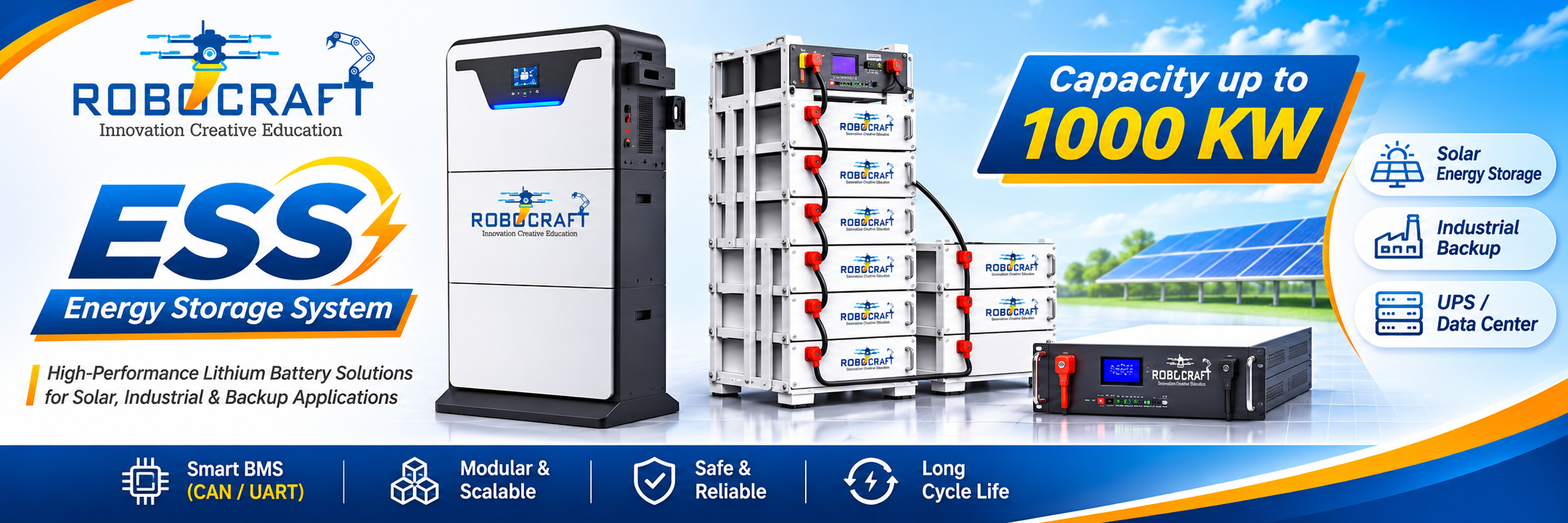
ROBOCRAFT IMPEX works with customized lithium battery manufacturing requirements for industrial and energy storage applications.
Customized Battery Requirements
- Battery chemistry: LiFePO4
- Nominal battery voltage
- Battery capacity in Ah
- Energy capacity in kWh
- Required discharge current
- Battery module configuration
- Battery rack dimensions
- BMS specifications
- CAN / RS485 communication requirements
- Cooling requirements
- Enclosure design
- Project integration requirements
Applications for Customized ESS Batteries
- Commercial energy storage
- Industrial BESS
- Solar battery storage
- UPS battery systems
- Renewable energy applications
- Customized power storage systems
Frequently Asked Questions About ESS Batteries
1. What is an ESS battery?
An ESS battery is a rechargeable battery used to store electrical energy for later use in energy storage applications.
2. What is the difference between ESS and BESS?
ESS means Energy Storage System and can include different storage technologies. BESS specifically means Battery Energy Storage System.
3. Which battery chemistry is suitable for ESS?
LiFePO4 is commonly used in stationary energy storage applications. The appropriate chemistry depends on the project requirements and system design.
4. What is a LiFePO4 battery?
LiFePO4 stands for Lithium Iron Phosphate. It is a lithium battery chemistry used in electric, industrial and stationary energy storage applications.
5. What is the difference between kW and kWh?
kW measures electrical power, while kWh measures electrical energy.
6. What is a 1 MWh ESS?
A 1 MWh ESS has a nominal energy capacity of 1,000 kWh. Its power rating is specified separately.
7. What is the role of a BMS in ESS?
The BMS monitors battery parameters and manages battery protection and control functions according to its design.
8. What is the role of PCS in BESS?
The PCS manages electrical power conversion between the battery DC system and the AC electrical system.
9. What is an EMS in an energy storage system?
An EMS manages the operation of the energy storage system, including charging, discharging and energy management.
10. Can ESS batteries be connected to solar systems?
Yes. ESS batteries can be integrated with compatible solar inverters and electrical systems.
11. What is battery depth of discharge?
Depth of Discharge (DoD) represents the percentage of a battery’s rated capacity that has been discharged.
12. Can ESS battery capacity be customized?
Yes. Battery configurations can be developed according to project-specific voltage, capacity, dimensions and operating requirements.
13. What is a containerized BESS?
A containerized BESS is a battery energy storage installation housed in a container or suitable enclosure with integrated electrical and control equipment.
14. How long can an ESS provide backup power?
Backup duration depends on usable battery energy, connected load, system efficiency and permitted operating limits.
15. What information is required for an ESS battery quotation?
Typical requirements include nominal voltage, energy capacity, power rating, battery chemistry, application, backup duration, dimensions and communication requirements.
Why Choose ROBOCRAFT IMPEX for ESS Battery Solutions?
ROBOCRAFT IMPEX focuses on lithium battery manufacturing and customized battery solutions for industrial and energy storage applications.
Our product and solution areas include:
- LiFePO4 lithium battery packs
- Customized ESS battery packs
- Industrial energy storage batteries
- Battery modules and rack configurations
- Smart BMS integration
- Battery monitoring and communication systems
- Customized lithium battery manufacturing
- Industrial and commercial battery applications
We work to understand the technical requirements of each project and discuss suitable battery configurations based on the intended application.
Discuss Your ESS Battery Project with ROBOCRAFT
Looking for a Customized LiFePO4 ESS Battery Manufacturer?
Planning an industrial energy storage project, commercial BESS installation or solar battery storage system?
Share your project requirements with ROBOCRAFT IMPEX. Our team can discuss suitable battery chemistry, voltage, capacity, battery configuration and customization requirements.
Contact ROBOCRAFT IMPEX
Website: https://robocraftstore.com
Email: sales@robocraftstore.com
ROBOCRAFT IMPEX
Innovation Creative Education
Powering Innovation. Driving the Future.
