
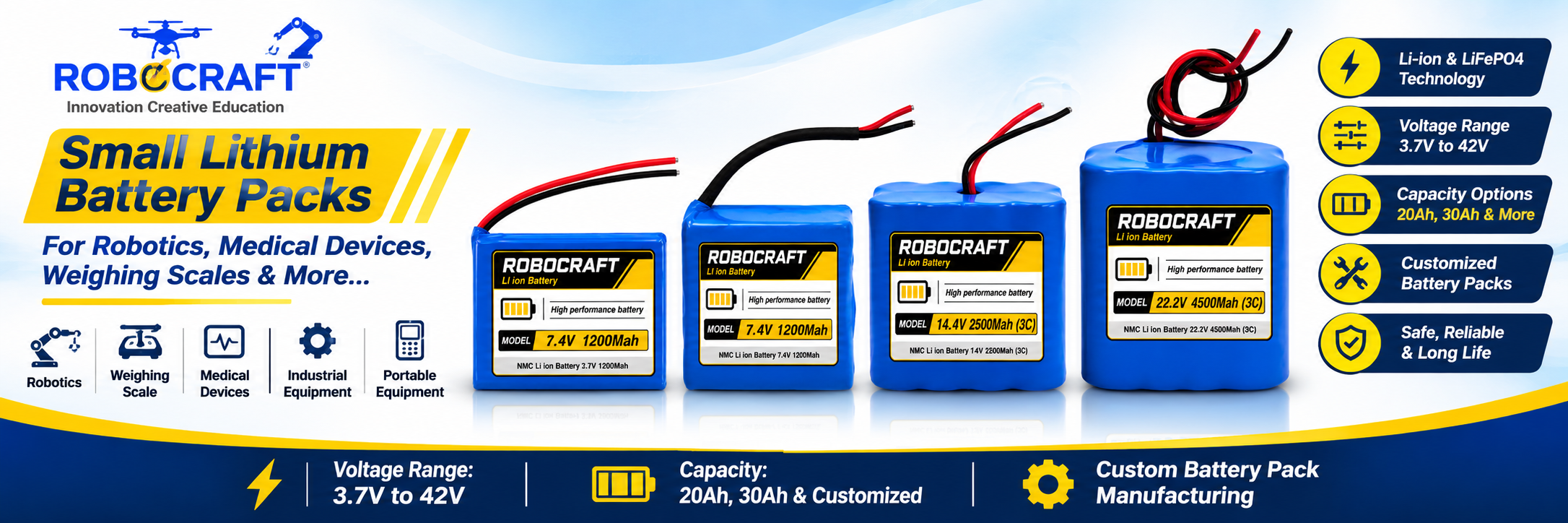
Lithium battery packs power almost everything that moves or works without a cable – electric scooters, robots, medical devices, weighing scales, drones, solar systems and inverters. This guide explains the main lithium chemistries, standard pack voltages, how a pack is built, and how to choose the right battery for your application in India.
3.7V–72V
Custom pack voltages
NMC · LFP · LiPo
Chemistries
With BMS
Every pack protected
Pan-India
Delivery from Ahmedabad
What is a lithium battery pack?
A lithium battery pack is a group of rechargeable lithium cells joined in series (S) to raise voltage and in parallel (P) to raise capacity, protected by a Battery Management System (BMS) and finished with wires, connectors and a casing. A “4S2P 18650 pack”, for example, has 4 cells in series and 2 in parallel – 8 cells giving 14.8V nominal.
Types of lithium batteries
| Type | Cell voltage | Strengths | Typical uses |
|---|---|---|---|
| Lithium-ion (NMC) | 3.6–3.7V | High energy, light, compact | EV scooters, e-bikes, robotics, portable devices |
| LiFePO4 (LFP) | 3.2V | Very safe, 2000–4000 cycles | Solar, inverters, ESS, e-rickshaws, loaders |
| Lithium polymer (LiPo) | 3.7V | Thin, any shape, high bursts | Drones, RC models, slim devices |
For a deeper comparison read lithium vs lithium-ion batteries and Li-ion vs LiPo.
Standard lithium pack voltages
| Nominal voltage | NMC series | LiFePO4 series | Common applications |
|---|---|---|---|
| 3.7V / 3.2V | 1S | 1S | Torches, small electronics, IoT |
| 7.4V / 6.4V | 2S | 2S | Weighing scales, toys, handheld devices |
| 11.1V / 12.8V | 3S | 4S | Routers, CCTV, medical devices, lead-acid replacement |
| 14.8V | 4S | – | Robotics, drones, power tools |
| 24V / 25.6V | 7S | 8S | AGVs, wheelchairs, small solar |
| 36V / 48V | 10S / 13S | 12S / 16S | E-bikes, scooters, telecom, home ESS |
| 60V / 72V | 16S / 20S | 20S / 24S | Electric scooters and motorcycles |
How a lithium battery pack is built
- Cells – cylindrical 18650, 21700, 26650 or 32650 cells, or prismatic and pouch cells. Cell quality decides pack life. See our lithium cells.
- Grading – every cell is tested and matched for capacity and internal resistance before assembly.
- Spot welding – pure nickel strips welded to the cells; no soldering on cell terminals.
- BMS – protects against overcharge, over-discharge, over-current, short circuit and heat, and balances the cells.
- Insulation and casing – fish paper, PVC shrink, ABS or metal case; waterproof IP65–IP67 options.
- Connectors – JST, XT60, XT90, Anderson or the customer’s own connector.
Where lithium battery packs are used
| Industry | Example products | Typical pack |
|---|---|---|
| Electric mobility | Scooters, e-bikes, e-rickshaws | 48V–72V, 20–60Ah |
| Solar and backup | Inverters, ESS, solar street lights | 12.8V–51.2V LiFePO4 |
| Robotics and automation | AGVs, robots, trolleys | 14.8V–48V |
| Medical | Monitors, portable equipment | 7.4V–14.8V |
| Weighing and retail | Weighing scales, POS machines | 3.7V–7.4V |
| Drones and UAVs | Agricultural and survey drones | 6S–14S high-discharge |
| Telecom and IT | Routers, BTS, UPS | 12V–48V |
How to choose the right lithium battery pack
- Voltage – match your device or controller (see the table above).
- Capacity (Ah or mAh) – decides run time. Run time ≈ capacity × voltage ÷ load in watts.
- Discharge current – motors and drones need high-drain cells and a BMS rated for peak current.
- Chemistry – NMC for light weight; LiFePO4 for long life and safety.
- Size and weight – share the space available so the pack is designed to fit.
- Charger – use a charger made for the pack’s voltage and chemistry. Read our charger guide.
Popular lithium battery packs
Lithium battery safety tips
- Buy packs with a proper BMS and graded cells from a known manufacturer.
- Never charge a swollen, dented or water-damaged pack.
- Charge on a non-flammable surface and away from heat.
- Store at 40–60% charge if unused for weeks.
- Keep terminals covered to avoid short circuits.
Frequently asked questions
How long does a lithium battery pack last?
A good NMC pack lasts 500–1500 cycles (2–5 years); a LiFePO4 pack lasts 2000–4000 cycles (5–10 years), depending on use and charging.
Can you make a custom lithium battery pack?
Yes. Robocraft builds custom packs from 3.7V to 72V in NMC or LiFePO4, sized to your device, with the right BMS and connector.
Is a lithium battery better than lead-acid?
Lithium is about one-third the weight, lasts 3–5 times longer, charges faster and needs no maintenance. It costs more upfront but less per cycle.
What is the difference between mAh and Ah?
1 Ah = 1000 mAh. Small packs are rated in mAh (e.g. 2600mAh), larger packs in Ah (e.g. 30Ah).
Do you deliver across India?
Yes, Robocraft ships lithium battery packs across India from Ahmedabad, Gujarat.
Get a custom lithium battery pack
Robocraft Impex, Ahmedabad, designs and manufactures custom lithium-ion and LiFePO4 battery packs from 3.7V to 72V for robotics, medical, weighing scales, EVs, solar and ESS. Share your voltage, capacity, size and application and we will send a quote.
