
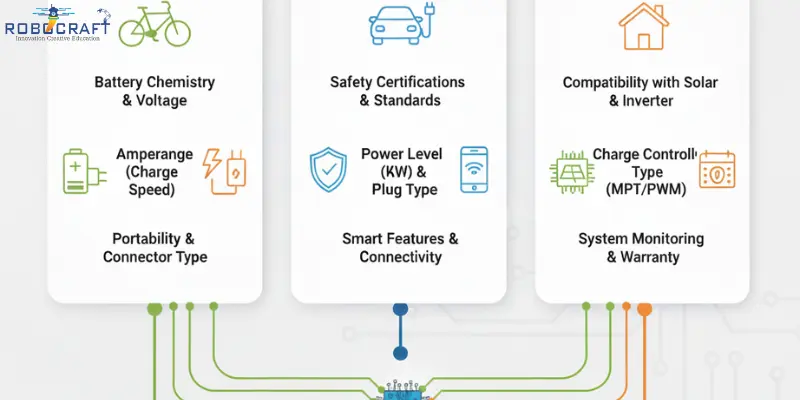
A good battery can be ruined by the wrong charger. Lithium-ion and LiFePO4 batteries need a charger with the exact full-charge voltage, a sensible charging current and the right connector. Get these three right and your e-bike, scooter or home battery will charge safely and last longer.
This guide shows how to pick a lithium battery charger for 24V to 72V e-bikes and EV scooters, how long charging takes, and the safety points every owner should know.
24V–72V
Charger range
0.2C–0.5C
Safe charge rate
CC/CV
Charging method
Auto cut-off
Full-charge protection
Why a lithium battery needs a lithium charger
Lithium batteries charge in two stages: constant current (CC) until the pack nears full voltage, then constant voltage (CV) while the current tapers off. A lithium charger stops at the correct voltage and does not keep “floating” the battery.
Lead-acid chargers use different voltages and a float stage. Using one on a lithium pack can over-charge cells, trip the BMS repeatedly or shorten battery life. If you have upgraded from lead-acid to lithium, upgrade the charger too. We stock both lithium chargers and lead-acid chargers, so always match the charger to the battery chemistry.
Step 1: Match the full-charge voltage
The number printed on your battery (48V, 60V, 72V) is the nominal voltage. The charger’s output must equal the pack’s full-charge voltage, which depends on the cell chemistry and the number of cells in series (the “S” number on the label).
| Battery (nominal) | Chemistry | Cells in series | Charger output (full charge) |
|---|---|---|---|
| 24V | Li-ion (NMC) | 7S | 29.4V |
| 36V | Li-ion (NMC) | 10S | 42V |
| 48V | Li-ion (NMC) | 13S | 54.6V |
| 60V | Li-ion (NMC) | 16S | 67.2V |
| 72V | Li-ion (NMC) | 20S | 84V |
| 12.8V | LiFePO4 | 4S | 14.6V |
| 25.6V | LiFePO4 | 8S | 29.2V |
| 51.2V | LiFePO4 | 16S | 58.4V |
Some 60V packs are built as 17S, which needs a 71.4V charger. Always check the cell count on your battery label or ask us before buying. This is why a “72V 10A” charger is often labelled 84V: 84V is its full-charge output for a 20S lithium-ion pack.
Step 2: Choose the charging current (amps)
Charging current decides how fast the battery charges. For long battery life, most packs are happiest at around 0.2C to 0.5C, meaning 20% to 50% of the battery’s Ah rating. Always stay within the maximum charge current written on the battery or BMS.
| Battery | 6A charger | 10A charger | 15A charger |
|---|---|---|---|
| 20Ah | about 3.5–4 hours | about 2–2.5 hours | check BMS limit |
| 30Ah | about 5.5–6 hours | about 3.5 hours | about 2.5 hours |
| 40Ah | about 7–8 hours | about 4.5 hours | about 3 hours |
Times are approximate from empty, including the slower CV stage at the end. A simple rule: charging time ≈ (Ah ÷ charger amps) × 1.1 to 1.2.
Step 3: Check the connector and polarity
- Match the plug type (2-pin, 3-pin, XLR or the scooter maker’s own socket).
- Confirm positive and negative pins match; reversed polarity can damage the BMS.
- For branded scooters, use a charger made for that model’s socket, or ask us to fit the right connector.
Step 4: Look for build quality and protections
- Aluminium body: spreads heat better than plastic, useful for 10A and 15A chargers.
- Cooling fan: helps on higher-current chargers in Indian summers.
- Protections: short-circuit, over-voltage, over-temperature and reverse-polarity protection.
- Status LED: red while charging, green when full, so you know when to unplug.
Chargers for e-bikes, scooters and home batteries
- E-bikes and e-cycles: usually 24V or 36V packs with 2–5A chargers.
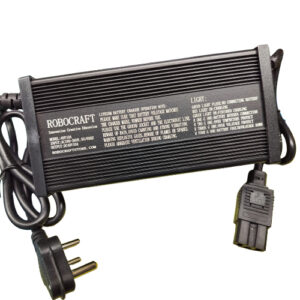
- Electric scooters: 48V, 60V or 72V packs with 6A to 15A chargers. Robocraft offers 48V, 60V and 72V lithium chargers, including aluminium-body models; see the full range of EV battery chargers.
- Home backup and solar batteries: these are normally charged by the inverter or an MPPT solar charge controller; make sure it has a lithium or LiFePO4 charging profile.
Need a new battery as well? Browse EV scooter batteries in 48V, 60V and 72V.
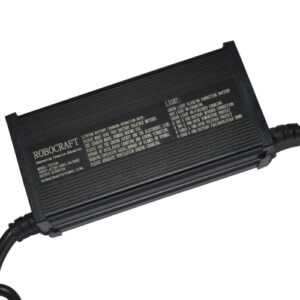
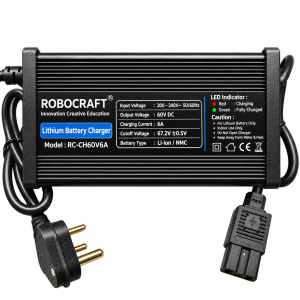
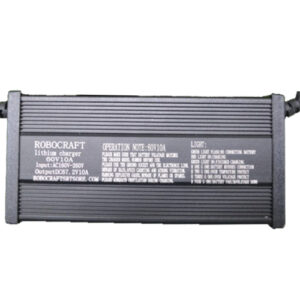
Popular lithium chargers
Safe charging habits
- Charge in a dry, ventilated place, away from anything flammable.
- Let a hot battery cool down after a ride before charging.
- Unplug once full; don’t leave it on charge for days.
- Don’t charge a swollen, damaged or wet battery; get it checked first.
- For long storage, keep the battery around 50–70% charged and top it up every month or two.
Frequently asked questions
Can I use a lead-acid charger for a lithium battery?
No. The voltages and charging stages are different, which can over-charge lithium cells or confuse the BMS. Use a charger made for your lithium chemistry and voltage.
Can a 48V charger charge a 60V battery?
No. The charger must match the pack’s full-charge voltage. A 48V lithium charger (54.6V) cannot fully charge a 60V pack, and a higher-voltage charger can damage a lower-voltage pack.
Is a faster charger bad for the battery?
Charging within the battery’s rated current is fine. Very high currents create more heat and wear; for daily use, moderate charging (around 0.2C–0.5C) gives the longest life.
How do I know when the battery is full?
Most chargers switch their LED from red to green when charging is complete and the current has dropped to a low level.
Why does my charger say 84V when my scooter is 72V?
72V is the nominal pack voltage. A 20S lithium-ion pack is full at 84V, so the charger is designed to output 84V.
Not sure which charger fits?
Robocraft supplies lithium-ion and LiFePO4 chargers from 24V to 72V for e-bikes, scooters and EVs. Share your battery voltage, Ah and connector type and we will suggest the right charger.
