

The PMSM (Permanent Magnet Synchronous Motor) has become the motor of choice for modern electric scooters, motorcycles, three-wheelers and cars. It delivers high efficiency, strong torque and smooth, quiet operation. This guide explains how a PMSM works, how it compares with BLDC and induction motors, and how to choose a PMSM motor and controller for your EV.
90–95%+
Typical efficiency
FOC
Sine-wave control
48V–72V+
EV voltages
Regen
Braking support
What is a PMSM motor?
A PMSM is an AC motor with permanent magnets on the rotor. The controller feeds the stator with three-phase sinusoidal current, creating a rotating magnetic field; the rotor turns exactly in step (synchronously) with it. Because no current is needed to magnetise the rotor, losses are low and efficiency is high across a wide speed range.

Types of PMSM
- Surface-mounted PMSM (SPMSM) – magnets on the rotor surface; simple and smooth, common in hub and mid-drive EV motors.
- Interior PMSM (IPMSM) – magnets buried inside the rotor; extra reluctance torque and wide high-speed range, used in many EVs.
PMSM vs BLDC vs induction motor
| Feature | PMSM | BLDC | Induction (AC) |
|---|---|---|---|
| Drive current | Sinusoidal (FOC control) | Trapezoidal | Sinusoidal |
| Efficiency | Very high (often 90–95%+) | High | Good |
| Torque ripple / noise | Very low – smooth and quiet | Some ripple and hum | Low |
| Power density | High | High | Lower |
| Cost | Higher (magnets, controller) | Lower | Moderate |
| Typical use | Performance scooters, motorcycles, cars | E-bikes, budget scooters, e-rickshaws | Industrial drives, some EVs |
Advantages of PMSM in EVs
- More range from the same battery thanks to higher efficiency.
- Strong torque from standstill for quick pickup and hill climbing.
- Smooth, silent operation with field-oriented control (FOC).
- Effective regenerative braking.
- Compact size and weight for the power delivered.
Choosing a PMSM motor and controller
- Power – match to vehicle weight, top speed and gradients (e.g. 1.5–3 kW for scooters, 5–10 kW+ for motorcycles and three-wheelers).
- Voltage – 48V, 60V, 72V or higher, matched with your battery. See our EV battery guide.
- Controller – a matched FOC controller with the right current rating and encoder/Hall input.
- Mounting – hub, mid-drive or axle; check shaft, sprocket and mounting pattern.
- Cooling – air-cooled for most two-wheelers; liquid-cooled for high continuous power.
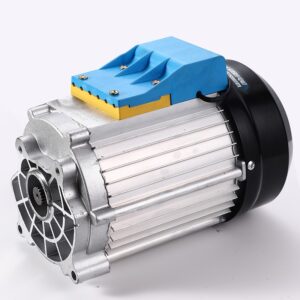
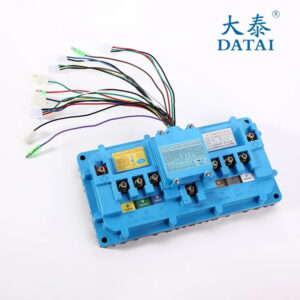
PMSM motors and controllers
Frequently asked questions
Is PMSM better than BLDC?
PMSM is smoother, quieter and usually more efficient; BLDC is simpler and cheaper. For performance EVs PMSM is generally preferred.
Can a PMSM motor run on a BLDC controller?
It may run, but not smoothly or efficiently. Use a sine-wave FOC controller designed for PMSM.
What voltage do PMSM EV motors use?
Two-wheelers commonly use 48V–72V; larger vehicles use higher voltages.
Do PMSM motors need maintenance?
Very little – mainly bearings and connectors. Keep the motor dry and avoid overheating, which can weaken magnets.
Get a PMSM drive for your EV
Robocraft supplies PMSM motors, matched FOC controllers and lithium battery packs for EV builders and conversions across India. Share your vehicle weight, target speed and voltage and we will suggest the right drive.
